Feb 10, 2026
By Jonathan Decker

E&O Insurance for Wealth Managers: Protecting Against Private Markets & SEC Scrutiny

E&O Insurance for Wealth Managers: Protecting Against Private Markets & SEC Scrutiny
Investment Advisor Interests
Human-created Content

Key Takeaways (TL;DR)

E&O insurance has become critical for wealth managers in 2026 as litigation risk increases, regulatory scrutiny intensifies and client expectations rise. While private-market investments are contributing to higher claim frequency across the industry, not all such activity is eligible for coverage under every E&O program. Advisors must understand where coverage applies, where exclusions exist and how documentation, supervision and disclosure practices affect claim outcomes.

Private-market activity has become a major driver of E&O claims across the industry, but coverage availability depends on whether the underlying investments fall within the scope of an advisor’s E&O policy. Certain strategies, including private equity, private placements and unregistered securities, may be excluded under programs such as NAPA Premier.

Wealth managers/RIAs operate at the intersection of investment strategy, financial planning, fiduciary duty and client relationship management, which is a landscape defined by rising expectations and increasingly complex risks. In 2026, advisory firms face intensifying pressure from clients, regulators and markets, all of which magnify the consequences of even small mistakes. As a result, Errors and Omissions (E&O) insurance has become one of the most important foundational protections in the modern wealth manager’s business model.

E&O insurance is no longer viewed as a procedural requirement or a commodity policy. Instead, it serves as a critical safeguard that protects firms from costly client disputes, operational errors, market misunderstandings and allegations of negligence or breach of fiduciary duty. This article explains why E&O has become essential for wealth managers, how coverage has evolved alongside private markets and digital tools and what advisors should understand when structuring E&O programs for 2026 and beyond with an RIA-focused insurance partner such as NAPA Premier.

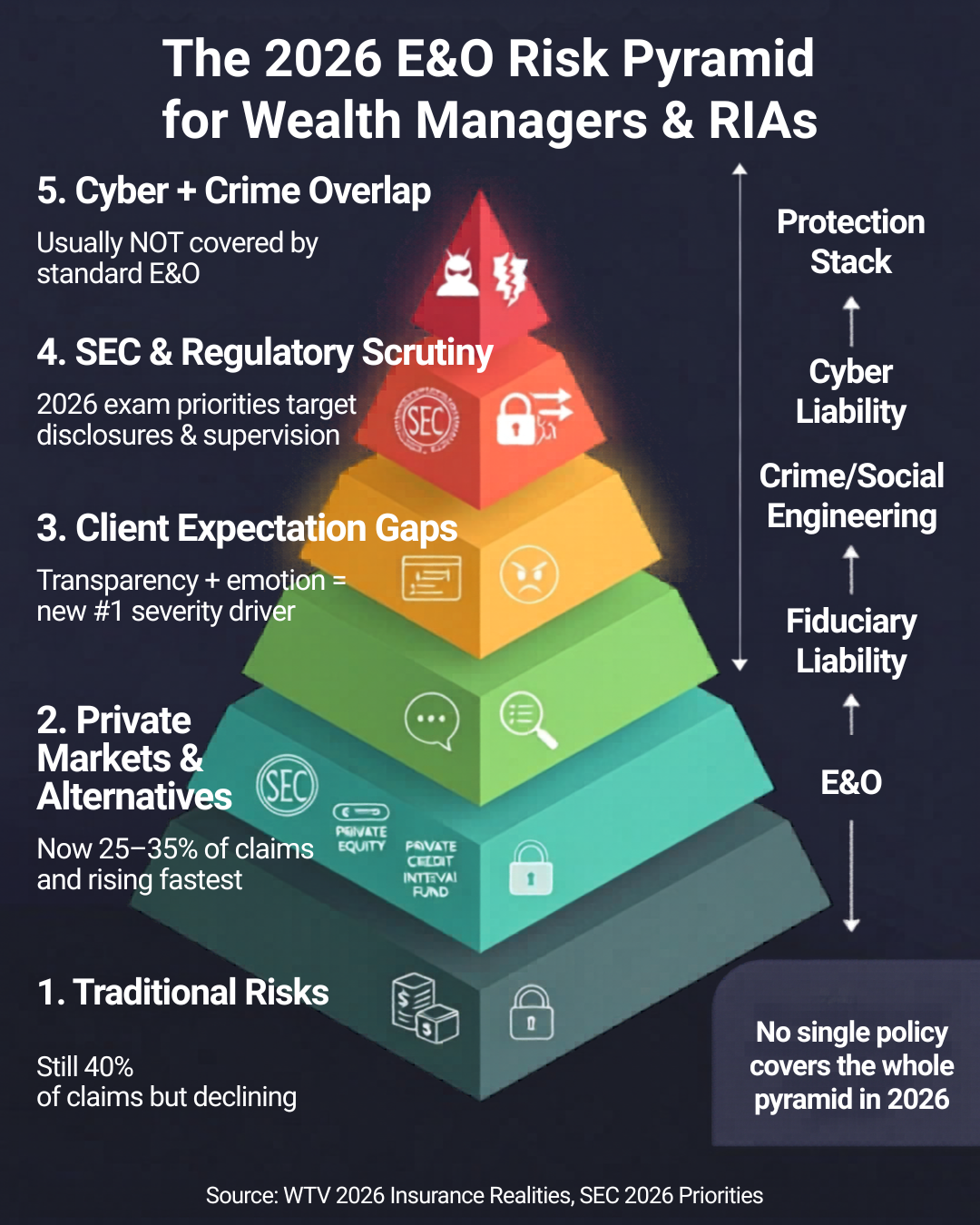
The 2026 E&O Risk Pyramid for Wealth Managers & RIAs


The Rising Risk Environment Wealth Managers Face

Wealth managers today shoulder broader responsibilities than ever before. Clients rely on them for investment guidance, tax awareness, estate coordination, risk management, custom planning and emotional reassurance during periods of volatility. That expanding role comes with expanding liability.

Client sophistication and evolving expectations

Modern wealth-management clients are more informed, more data-driven and more demanding. They expect real-time updates, instant access to information and proactive guidance around market shifts. As their expectations rise, so does their willingness to question performance shortfalls, misunderstandings or unexpected outcomes.

Notably, high-net-worth (HNW) and ultra-high-net-worth (UHNW) clients often possess legal sophistication and are more likely to pursue claims when disputes arise. Even minor administrative missteps or communication gaps can become the foundation for litigation if a client believes their advisor failed to meet a professional obligation.

A more complex investment universe

Portfolio construction now often spans:

  • Private credit and private equity
  • Structured notes
  • Interval funds
  • Alternative yield strategies
  • Tax-advantaged products
  • ESG and thematic investments

Each brings unique risks — valuation challenges, liquidity constraints, gating events, complex fee structures — that increase the potential for misunderstanding or misrepresentation. Advisors who once dealt primarily with stocks and bonds now analyze opaque private-market information, manage due diligence expectations and explain risks that clients may not fully understand.

While private-market activity is contributing to higher claim frequency across the industry, coverage availability depends on whether the underlying investments fall within the scope of the advisor’s E&O policy. Certain strategies may be excluded under programs such as NAPA Premier.

2025-2026 Trends: Private Markets Drive E&O Exposure

Per iCapital's 2025 survey, only 33% of RIAs offered private equity in 2022—now projected at 60%+, with valuation opacity fueling 25% of disputes. SEC's 2026 priorities spotlight these for retail funds. Importantly, these trends explain why claim frequency and severity are increasing across the industry, not that E&O coverage universally applies to private-market activity.

Greater transparency and scrutiny

Technology has made portfolio oversight significantly easier for clients. Custodial dashboards, client portals and performance apps give clients near-instant visibility into holdings, performance and allocation decisions. While transparency is beneficial, it also increases the frequency of questions, disputes and “difference in expectation” claims — often tied to decisions the advisor made months earlier.


What E&O Insurance Actually Covers for Wealth Managers

E&O insurance for investment advisors protects wealth managers against claims alleging negligence, misrepresentation or errors in professional services. With advisory relationships built on trust and interpretation, disputes often arise not from misconduct, but from misalignment, misunderstanding or incomplete documentation.

Core protections within a strong E&O policy

E&O covers claims related to:

  • Professional negligence
  • Incorrect recommendations or investment strategies
  • Inaccurate performance explanations
  • Misinterpretations of client objectives
  • Administrative or operational mistakes
  • Failure to execute or follow instructions
  • Breach of fiduciary duty
  • Disclosure and documentation errors

For most wealth managers, E&O becomes the central defense mechanism when a client claims financial loss due to alleged poor advice or mismanagement.

Where E&O is most critical in real-world scenarios

E&O insurance becomes most valuable when a client experiences a loss and questions the advisor’s actions, recommendations or documentation. Many disputes emerge not from poor advice, but from mismatched expectations and documentation gaps that leave room for differing interpretations. In practice, many claims arise from small but consequential miscommunications — a missed instruction, a misunderstood risk disclosure or an allocation change the client later disputes. These issues rarely stem from misconduct; rather, they emerge when expectations diverge between the client and the advisor.

For example, a wealth manager may make a well-intentioned tactical shift during a period of heightened volatility, only to have the client disagree weeks later when short-term results do not align with their expectations. Another common scenario involves misapplied model portfolio changes where certain accounts receive updates while others do not due to a workflow oversight. These operational inconsistencies can become grounds for E&O claims if the firm cannot demonstrate clear documentation or supervisory controls.

E&O also plays a central role when communication records conflict with a client’s recollection of a conversation. If the advisor believes a client understood the liquidity constraints of a private-market investment, but the client later alleges they were misled, the dispute may hinge entirely on documentation quality. In these situations, the availability of coverage depends on whether the underlying investment activity is eligible under the advisor’s E&O policy, making documentation and suitability records especially important.

What E&O does not cover

Despite its importance, E&O insurance is not a catch-all solution for every type of loss. It specifically protects against claims tied to professional services, not broader operational or technology failures. Cyberattacks, data breaches and system compromises generally fall outside the scope of E&O unless the policy contains explicit cyber endorsements. Likewise, custodial errors, fraudulent activity by third parties and breaches of systems the advisor does not control are typically excluded. It generally excludes:

  • Fraud or intentional wrongdoing
  • Market-wide downturns unrelated to advice
  • Custodial breaches
  • Cyber incidents unless specifically endorsed
  • Losses from products outside the advisor’s approved list
  • Regulatory fines or penalties

Scenario

E&O Coverage

Exclusions/Notes

Suitability Dispute (e.g., aggressive alts allocation)

Covered (if documented)

Requires IPS/risk assessment proof

Private-Market Misrepresentation1

⚠️ Coverage depends on whether the investment is an eligible, publicly traded security under the policy

Excludes intentional fraud; needs disclosure records

Cyber Breach (e.g., data leak)

Excluded

Needs cyber endorsement; supervisory gaps may trigger

Market Downturn Claim

Not Covered

Must prove unrelated to advice

Regulatory Fine

Excluded

Fines/penalties always out-of-scope

Caption: Source: Based on 2025-2026 trends from WTW & SEC priorities. Coverage varies by policy.

1: Certain E&O programs, including NAPA Premier, exclude private equity, private placements and securities not registered with the SEC.

E&O policies also do not cover losses that stem purely from market conditions — even when clients express dissatisfaction or attempt to attribute normal volatility to advisor mistakes. And because E&O focuses on unintentional errors, any scenario involving intentional misconduct, fraudulent behavior or regulatory fines sits outside the policy’s protection zone. This is why E&O must integrate with other coverages, including cyber liability insurance, fidelity bonds and fiduciary liability.

This is also why wealth managers increasingly rely on complementary policies to create a cohesive risk-management framework. E&O remains foundational, but it must function in tandem with other protections.


Common E&O Claims in Wealth Management

To understand the importance of E&O insurance, it helps to see what drives the most claims. The most common E&O claims across the wealth-management industry reflect the reality that advisory work is built on judgment, communication and interpretation. The most frequent categories reflect the nature of modern advisory relationships and are outlined in the following sections.

Misrepresentation and inadequate disclosure

Misrepresentation and disclosure disputes remain one of the most frequent claim types. Clients may assert that they were not adequately informed about liquidity risks, embedded fees, tax implications or the nature of complex products, especially when investments underperform or appear to behave differently than expected. Some common examples are:

  • Liquidity restrictions
  • Fees or embedded costs
  • Tax implications
  • Valuation uncertainty
  • The risks of structured or alternative products

These disputes often involve misunderstandings rather than deceit — but they are still grounds for E&O claims.

Suitability and allocation disputes

Suitability remains the most common E&O claim category across all wealth-management segments. Advisors may believe they have built portfolios aligned with stated objectives, but clients often reassess their risk tolerance after adverse market events. During market downturns, clients may allege their portfolio was too aggressive, too conservative or insufficiently diversified based on their stated objectives.

In these cases, the advisor’s documentation is critical to keep on file, including investment policy statements, meeting notes and risk assessments. Without a clear record, clients may argue that the allocation was inappropriate given their needs.

Supervisory failures within growing firms

As firms scale, supervisory consistency often becomes harder to maintain and even minor gaps can escalate into significant E&O exposure. As teams expand, inconsistencies emerge in how junior advisors communicate, trade or document decisions. Underwriters and regulators both pay close attention to these supervisory systems because gaps in oversight are strongly correlated with E&O claim frequency.

As wealth-management firms scale, E&O exposure increases through:

  • Junior advisor oversight
  • Delegated tasks
  • Trading errors
  • Documentation inconsistencies
  • Communication breakdowns across teams

Underwriters pay close attention to supervisory practices because they directly correlate with claims frequency.

Operational and administrative mistakes

Not all claims stem from investment decisions. Operational errors contribute to many claims as well. Missed distribution requests, administrative oversights, timing mistakes and misfiled forms can all escalate into disputes if they cause financial harm or client dissatisfaction.

Many of these claims arise from errors such as:

  • Incorrect contribution timing
  • Missed distribution requests
  • Mishandled forms
  • Delayed transfers
  • Misfiled documentation

Even small errors can result in large liabilities when they occur in HNW or UHNW accounts and reputational exposure and legal defense costs can be significant.

Claims tied to private-market investments

Finally, alternative and private-market investments present unique E&O risk. Valuation opacity, illiquidity, complex disclosures and market-driven gating events all increase the likelihood of client misunderstanding. Advisors who do not document the client’s informed consent and comprehension of these risks are particularly vulnerable.

Private-market allocations drive complex disputes because clients may not fully grasp:

  • Illiquidity
  • Lockups
  • Gated withdrawals
  • Opaque valuation methodologies
  • Underlying investment risk

These disputes often involve mismatched expectations and can lead to substantial E&O exposure. KKR projects RIA private exposure rising from 43% minimal allocations in 2025 to 91% significant by 2027.

While private-market activity is contributing to higher claim frequency across the industry, coverage availability depends on whether the underlying investments fall within the scope of the advisor’s E&O policy. Certain strategies may be excluded under programs such as NAPA Premier.


Why Rising Client Expectations Are Driving Demand for E&O

Client expectations in wealth management have evolved dramatically. Today’s clients expect a degree of personalization, transparency and real-time responsiveness that would have been impossible even a decade ago. Today clients expect wealth managers to serve not only as investment strategists, but also as trusted risk mitigators, financial educators and personal advisors. Those elevated expectations can intensify liability.

Evolving role of the advisor-client relationship

Clients now view wealth managers as long-term stewards of their financial well-being. This emotional and psychological dimension increases perceived advisor responsibility, even for events outside the advisor’s control. This shift has redefined the advisor-client relationship into one that feels more like a long-term partnership, but with that partnership comes heightened expectations of accountability.

Clients increasingly see wealth managers as multi-disciplinary guides responsible for not just investment performance, but also tax awareness, estate implications and long-term wealth planning. While many advisors fulfill these roles exceptionally, the expansion of perceived responsibility widens the potential for misunderstandings. When clients believe their advisor should have anticipated a risk or provided a particular caution, disputes can develop even if the advisor acted competently.

Client access to real-time data increases scrutiny

Technology has further intensified this dynamic. With mobile dashboards and performance apps offering daily insights, clients react more quickly to short-term volatility or unexpected fluctuations. Minor shifts that once went unnoticed now prompt questions, concerns or complaints; and when performance deviates from expectations, advisors are often first to blame. When they see short-term volatility or unexpected allocation changes, they may question whether the advisor acted properly — even when decisions were sound.

Interdisciplinary expectations create broader liability zones

This combination of immediate visibility, interdisciplinary expectations and emotional connection to financial outcomes has made E&O insurance a vital stabilizer for advisors. It protects against disputes that arise not simply from poor decisions, but from the evolving psychology of modern wealth-management clients.

Clients now expect wealth managers to understand (or coordinate with experts on):

  • Tax issues
  • Estate impacts
  • Cash-flow planning
  • Risk mitigation
  • Retirement modeling
  • Philanthropic strategy

Expanding advisory scope introduces new opportunities for misunderstanding, which can quickly escalate into E&O claims if expectations aren’t clarified.


Regulatory and Compliance Pressures Amplifying E&O Needs

Regulatory enforcement has intensified across fees, disclosures, cybersecurity and conflicts of interest. Wealth managers must treat compliance as both a supervisory obligation and a core risk-management function.

The SEC’s increased exam scrutiny

Regulatory bodies continue to increase their scrutiny of wealth managers. The SEC’s exam process has become more rigorous, with examiners requesting deeper documentation, more detailed explanations of investment decisions and clearer evidence of supervisory control. Even well-run firms can face exposure if exam findings reveal documentation inconsistencies or unclear disclosures.

SEC exam cycles now involve:

  • More detailed document requests
  • Deeper dives into advisor-client communication
  • Greater emphasis on fee accuracy
  • Enhanced evaluation of investment processes
  • Scrutiny of private-market disclosures

Even well-run firms may face claims triggered by exam findings.

Cybersecurity and operational risk overlap with E&O

Cybersecurity rules add another layer of complexity to E&O exposure. While most cyber events fall under cyber liability insurance, regulators now consider cybersecurity preparedness part of an advisor’s supervisory framework. If a breach leads to financial harm or operational disruption, clients may allege supervision failures or misleading representations of cybersecurity controls — both of which can trigger E&O claims even when no cyber endorsement is in place.

While cyber incidents are typically not covered under E&O unless endorsed, supervisory failures can create E&O exposure when:

  • Clients allege the advisor failed to protect sensitive data
  • Misleading statements about cybersecurity controls appear in marketing materials
  • Cyber incidents lead to portfolio errors or data misinterpretation

Conflicts of interest remain a regulatory focal point

Regulators continue targeting conflicts around:

  • Revenue sharing
  • Product incentives
  • Wrap-fee structures
  • Expense allocations
  • Proprietary products

These issues can rapidly escalate to E&O claims when clients allege harm or misalignment of interests.


How Private Markets and Complex Portfolios Increase Exposure

Private-market investments are no longer reserved just for institutional accounts. Today they are now widely used in sophisticated client portfolios. While these investments offer compelling opportunities, they come with inherent risks that increase E&O exposure.

Valuation ambiguity complicates reporting

Private investments inherently lack transparent pricing. Because valuations are updated periodically instead of continuously, they may not reflect evolving market conditions. When reported valuations shift unexpectedly or differ from client expectations, clients may question the accuracy of performance reporting or the advisor’s explanation of risk, often leading to disputes.

Liquidity risk is frequently misunderstood

Liquidity constraints create similar challenges. Clients may understand an investment is illiquid at purchase, but when markets change or personal needs arise, the inability to redeem can spark frustration, uncovering that they may not have fully grasped lockups, gating mechanics or redemption rules. Advisors often bear the burden of these frustrations, especially if documentation of the initial conversation was sparse.

Increased due diligence expectations

Due diligence expectations have also increased. Clients assume advisors have thoroughly vetted private-market offerings. If an investment fails or behaves differently than expected, clients may allege insufficient due diligence — even when the advisor did everything reasonably expected under industry standards. Clients expect advisors to:

  • Review offering documents
  • Analyze underlying strategies
  • Investigate the sponsor
  • Assess liquidity and operational risk

Any perceived gap (even when the advisor performed reasonable due diligence) can become the basis for an E&O claim if the documentation does not clearly support the advisor’s process.

Concentration, suitability and documentation gaps

If a private-market investment grows to a larger-than-expected percentage of a portfolio and underperforms, clients may allege poor supervision or improper allocations. These dynamics illustrate why wealth managers working with alternatives need not only strong documentation and communication but also robust E&O protection.

While private-market activity is contributing to higher claim frequency across the industry, coverage availability depends on whether the underlying investments fall within the scope of the advisor’s E&O policy. Certain strategies may be excluded under programs such as NAPA Premier.


How NAPA Premier Supports Advisors Facing Rising Liability Risk

NAPA Premier can support wealth managers by aligning coverage structure with the way advisory firms operate. For example, focusing on the firm’s business model, client profile, eligible investment activity and supervisory practices so coverage terms, exclusions and underwriting expectations are understood before a claim occurs.

Understand the firm’s client base and investment philosophy

Firms serving HNW or UHNW clients often face higher claim severity. In an E&O review, NAPA Premier evaluates how the firm describes its investment philosophy, how it documents suitability discussions and how it communicates risk so the insurance program matches the firm’s exposure and underwriting expectations.

Examine supervisory structures and documentation capabilities

Supervision and documentation are equally important. NAPA Premier helps firms present these controls clearly during underwriting by translating real workflows into the language underwriters look for, including training standards, review processes, IPS documentation and model oversight. Underwriters prioritize:

  • Training standards
  • Review workflows
  • Model portfolio oversight
  • Communication protocols
  • IPS documentation

Clarify the boundaries between E&O, cyber, fidelity bonds and fiduciary coverage

Finally, NAPA Premier clarifies the boundaries between E&O, cyber liability, fidelity bonds and fiduciary coverage so firms understand what responds, what is excluded and where endorsements or separate policies are needed. Many claims disputes arise because an advisor mistakenly believed one policy covered an event that ultimately fell under another. Clear differentiation helps reduce misunderstandings and sets more realistic expectations before a claim occurs.

Note: Fidelity bonds are not issued or placed by NAPA Premier; advisors are referred to Surety Solutions, an independent partner.

Preparing for underwriting intensity in 2026

In 2026, underwriters often ask more questions about:

  • Private-market exposure
  • Fee structures
  • Conflicts of interest
  • Cyber controls
  • Documentation habits
  • Client demographics

NAPA Premier helps advisors prepare for underwriting intensity so firms can pursue clearer terms and fewer surprises at renewal.


90-Day Checklist for Wealth Managers

Over the next 90 days, wealth managers can significantly strengthen their risk posture through targeted action. Wealth managers should begin by reviewing their current E&O policy to ensure that limits, exclusions and endorsements match the firm’s exposure, especially if private-market allocations or alternative strategies have grown in recent years. Next, firms should review their documentation practices, particularly around risk disclosures, suitability assessments and investment-policy adherence. Even small gaps in documentation can amplify liability if a dispute arises. Working with an RIA-focused insurance partner such as NAPA Premier, advisors can build a more resilient coverage strategy that protects the firm and its clients.

Wealth Manager Priorities

  • Review E&O limits, endorsements and exclusions
  • Review suitability documentation for high-risk clients
  • Reassess alternative and private-market exposure
  • Strengthen investment-policy and supervisory workflows
  • Evaluate communication logs and client disclosure clarity
  • Benchmark E&O limits against AUM/private exposure (aim $5M+ for HNW firms).

What to Prepare for Your NAPA Premier E&O Review

  • Gather current E&O, cyber and fidelity bond documents including endorsements and exclusions
  • Summarize client profile, AUM range and service mode
  • Document supervisory workflows, review practices and IPS usage
  • List eligible investment activity and any strategies that may be excluded under the policy
  • Identify recent operational changes, staffing changes or technology workflow changes that affect risk

Conclusion

Wealth managers face increasing liability as portfolios become more complex, regulatory scrutiny intensifies and client expectations evolve. E&O insurance remains an essential safeguard for eligible advisory activities, but advisors must understand where coverage applies and where exclusions exist. Firms that proactively strengthen documentation, clarify expectations and partner with an RIA-focused insurance team such as NAPA Premier will be best positioned to protect client trust and long-term business stability.

Apply Now


FAQ Section — E&O Insurance for Wealth Managers

1. What are the top E&O claims trends for wealth managers in 2026?

Suitability (40%+), misrepresentation in alts and supervisory gaps—driven by private markets & SEC scrutiny (Golsan Scruggs/WTW 2025-26).

2. How do private markets increase E&O risk for RIAs?

Opacity in valuation/liquidity leads to disputes; 60%+ RIAs now use them, per iCapital/KKR surveys. Strong docs mitigate. Coverage availability depends on whether the underlying investments are eligible under the advisor’s E&O policy and certain strategies may be excluded under programs such as NAPA Premier.

3. Why do wealth managers need E&O insurance?

Wealth managers need E&O insurance to protect against claims alleging negligence, misrepresentation or errors in professional advice. Even minor misunderstandings or administrative mistakes can escalate into costly disputes, making E&O essential for business stability and client trust.

4. What types of claims does E&O insurance typically cover for wealth managers?

E&O typically covers claims related to investment errors, misrepresentation, suitability disputes, communication failures and administrative mistakes. It also protects against supervisory failures and portfolio mismanagement allegations. However, while these disputes frequently lead to E&O claims, coverage availability depends on whether the underlying investment falls within the scope of the advisor’s policy.

5. How is E&O different from fiduciary liability insurance?

E&O covers professional services errors, while fiduciary liability focuses on breaches of fiduciary duty in ERISA-covered plans. Wealth managers often need both because they address different aspects of liability.

6. Do private-market investments increase E&O risk for wealth managers?

Yes. Private-market investments are contributing to higher claim frequency across the advisory industry due to valuation uncertainty, liquidity constraints and disclosure disputes. However, coverage availability depends on whether those investments are eligible under the advisor’s E&O policy. Programs such as NAPA Premier exclude private equity, private placements and securities not registered with the SEC.

7. Does E&O cover cyber incidents?

Generally no — unless the E&O policy explicitly includes cyber components. Most cyber incidents fall under cyber liability insurance, not E&O. However, supervisory failures tied to cyber events may trigger E&O claims.

8. How much E&O coverage should a wealth manager carry?

Coverage needs vary based on client demographics, assets under management, investment complexity and claims history. HNW/UHNW-focused firms or those using alternatives typically require higher limits.

9. What should wealth managers expect from an E&O review with NAPA Premier?

NAPA Premier reviews coverage limits, exclusions and endorsements alongside the firm’s client profile, supervisory workflows and documentation practices. We help advisors understand how underwriting evaluates these controls, where coverage gaps tend to appear and how E&O, cyber liability and fidelity bonds work together to reduce claim friction.

10. How often should wealth managers review their E&O policy?

Annually at minimum — but quarterly reviews are recommended for firms that frequently update their investment offerings, expand into new asset classes or adjust their advisory model.

Investment Advisor Interests
Human-created Content
About Jonathan Decker
Jonathan has been with NAPA since 2012 and is an account executive focused on Errors & Omissions (E&O) Insurance for Insurance Agents & Agencies. He holds 2-20 Property and Casualty and 2-15 Health and Life Agent licenses. A Bradenton, FL native, Jonathan earned a BS from Florida State University in 2011. Outside work, he enjoys golfing, playing fetch with his dog, reading, live concerts, running and the beach.


FREE Insurance Consultation with NAPA Premier
Have questions about RIA & IAR E&O Insurance, Cyber Liability Insurance, Social Engineering Endorsements & Bonds?

Schedule your free consultation with an insurance expert today to discuss your coverage needs, custodian requirements, pricing and next steps.


FREE Insurance Consultation with NAPA Premier
Have questions about RIA & IAR E&O Insurance, Cyber Liability Insurance, Social Engineering Endorsements & Bonds?

Schedule your free consultation with an insurance expert today to discuss your coverage needs, custodian requirements, pricing and next steps.