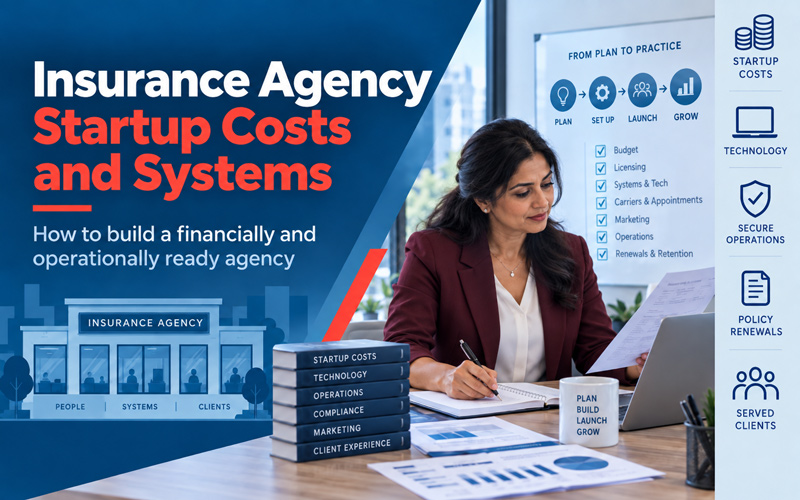
A practical guide to building a launch-ready business.
Key Takeaways
- Starting an agency takes more than a license and a business entity. You also need a workable business model, realistic market access and enough financial runway to support the early growth period.
- A strong niche sits at the intersection of client demand, your expertise, accessible insurance markets and account economics that make sense for the way you plan to operate.
- Licensing and entity formation open the doors. Consistent service, renewal discipline and clear recordkeeping help make the agency durable.
- Your E&O structure should reflect the agency entity, the people doing the work, the professional services you plan to provide and continuity of coverage.
Starting an Agency is More Than a Licensing Process
To start an insurance agency, you generally need to choose an agency model and target market, form and license the business, establish realistic carrier or market access, arrange appropriate insurance, build operating systems and create a plan for acquiring and retaining clients. Requirements vary by state, line of authority and business structure.
The harder part is making sure those pieces work together. You need to know that you can place the business you plan to pursue, service it consistently and support the operation while the book is still developing. A launch-ready agency starts with those decisions, not a logo or carrier wish list.
Is 2027 a Good Time to Start an Insurance Agency?
The independent agency channel remains substantial. The 2024 Agency Universe Study from Future One estimated approximately 39,000 independent property and casualty agencies in the United States, with 75% of surveyed agencies reporting revenue gains. One-third expected an ownership change within the next five years, while captive-to-independent conversions remained part of the agency landscape.
That does not make every market equally attractive. Carrier appetite can shift by line, territory and class, while recent premium increases should not be treated as guaranteed future growth. Before you launch, make sure the agency has a market it can serve well, a practical way to place the business and a plan to retain clients when conditions change.
Choose How You Will Enter Agency Ownership
Starting from scratch is only one path. You might buy a book, purchase an existing agency, step into a succession arrangement or use a network-supported launch model. Each option changes how much capital you need, how quickly revenue may develop, how much control you have and what servicing obligations you take on from day one.
|
Entry path |
Potential advantage |
Primary consideration |
|
Build from zero |
More control over the initial model |
Slower revenue and harder initial market access |
|
Buy a book |
Immediate clients and renewal opportunity |
Financing, retention and data quality |
|
Buy an agency |
Existing operations and relationships |
Higher capital need and inherited obligations |
|
Succession or partnership |
Mentorship and gradual transition |
Ownership and control terms |
|
Network-supported launch |
Potentially faster market access |
Fees, contract limits and portability |
If you are moving from a captive environment, review client ownership, solicitation, confidentiality and other transition restrictions before you act. NAPA’s guide to transitioning from captive to independent addresses that decision point in more detail.
Define Your Market, Product Mix and Agency Model
“Choose a niche” is common startup advice, but the niche only works if you can actually serve it. A contractor-focused agency, for example, needs more than contractor leads. You need underwriting familiarity, appropriate carrier or wholesale access and a service model that can handle certificates, audits, exposure changes and renewals without losing consistency.
Viable agency niche = client need + relevant expertise + realistic market access + sustainable economics
Pressure-test the market before you build around it. Look at likely account size, retention potential, service workload, geographic concentration and realistic placement alternatives. Then decide which lines fit the model and whether you intend to operate as a specialist or generalist, locally or across multiple states, on your own or with a team. Each added state, product line or producer relationship creates more operational responsibility.
Create the Business and Financial Plan
Build the budget around the agency you actually plan to run, not a generic startup estimate. Formation costs are only the beginning. You also need to account for recurring expenses and enough runway to absorb slower production, uneven commission timing or a marketing channel that takes longer than expected to prove itself.
Keep revenue projections grounded in client and policy growth rather than premium increases alone. Insurance Agency Startup Costs and Systems goes deeper into budgeting, revenue assumptions, technology and the first-year operating model.
Build a Realistic Carrier and Market-Access Strategy
New agencies may reach insurance markets through direct appointments, agency networks, aggregators, managing general agents, wholesalers or excess and surplus lines brokers. Which options are realistic will depend on your experience, geography, product mix, expected volume and current carrier appetite.
Before you launch, identify a practical primary and backup placement path for the clients you intend to pursue. Also understand what the relationship means for commissions, book ownership and your options if that access changes later. How New Insurance Agencies Secure Carrier Access compares these structures in more detail.
Form and License the Agency
Formation usually includes selecting a business structure, registering the entity, obtaining an employer identification number, opening business accounts and securing the licenses required for the individuals and business entity involved. Some states may also require a designated responsible licensed producer or a similar role.
Licensing rules vary by state and line of authority, so verify current requirements through NIPR and the applicable state department of insurance. Decisions involving ownership, contracts or tax treatment may also warrant review by qualified legal or tax professionals.
Arrange E&O and Other Agency Insurance
E&O insurance is often required by carriers or business partners, but it should not be treated as just another appointment document. As you set up the agency, review whether the entity is insured, which owners, employees or contractors are included and whether the professional services and product lines you plan to handle fit the policy structure.
Moving from individual producer to agency owner can also change the E&O structure you need to evaluate. A sole producer operating through a business entity may not present the same coverage structure as a retail agency with multiple producers, employees or contractors. The right approach depends on how the business is organized, who is performing professional services and the applicable policy eligibility and terms.
If you are unsure whether your operation should be considered for individual agent or agency E&O, review NAPA’s Agent or Agency Policy resource before beginning client work.
Many E&O policies are written on a claims-made and reported basis, which makes continuity, prior-acts dates and reporting requirements important to understand. Limits, retentions and the treatment of defense costs can matter as well. Coverage for any claim will depend on the applicable policy terms, conditions, exclusions, eligibility and facts.
Other business insurance may also be appropriate depending on how and where the agency operates. The right structure should reflect your actual people, locations, systems and services rather than a generic startup checklist.
Build the Operating System Before the First Policy
Decide how work should move through the agency before the first policy is written. That includes how you gather client information, review applications, record recommendations and client decisions, deliver policies, handle service requests and prepare for renewals. Building the first renewal process early is especially useful because it forces you to define ownership and documentation standards before the book becomes harder to manage.
Then choose technology that supports the process. An agency management system, CRM, secure document storage and e-signature tools can help, but software does not create a sound workflow on its own. Insurance Agency Startup Costs and Systems provides a deeper framework for technology, client records, renewals and staffing controls.
Protect client data and govern AI use
Put basic data-security controls in place before client information begins moving through the agency. That includes multifactor authentication, individual user access, approved storage, backups and prompt offboarding. If you use AI, define approved tools and uses, restrict sensitive data and require human review. Carrier and policy information should always be verified against authoritative sources. AI can support professional judgment, but human oversight still matters and should have the final say in a decision.
Create a Client Acquisition and Retention Plan
Define the client experience before you scale marketing. Who is the right fit for the agency? How quickly will you respond? When will renewal reviews begin? How will you explain a difficult renewal, a carrier appetite change or a coverage option the client declines? Those decisions shape retention just as much as your lead sources do.
Treat retention as part of the startup model, not something to solve later. Track whether the agency is keeping the right clients and meeting its own communication standards instead of measuring success only by new-business volume. For practical strategies that can improve client loyalty and long-term profitability, explore our article on client retention best practices for insurance agents.
Complete a Pre-Launch Readiness Review
- Confirm the target market, product mix and agency model
- Confirm primary and backup market-access paths
- Verify entity and licensing requirements
- Test startup costs, operating expenses and financial runway
- Review material contracts and transition restrictions
- Arrange E&O and other insurance appropriate to the actual operation
- Document service, renewal, data-security and supervision processes before scaling
Focus the first year on controlled growth
|
Phase |
Primary focus |
|
First 90 days |
Validate market access, test workflows and monitor the cost and quality of new business. |
|
Months 4 to 8 |
Refine the target market, improve submission quality and prepare for initial renewals. |
|
Months 9 to 12 |
Review retention, carrier concentration, staffing needs and whether expansion is justified. |
Do not add another state, line of business or producer relationship until the agency can consistently service and document the business it already has.
A Practical Next Step
Before the first client engagement, make sure the E&O structure reflects the agency entity, the licensed professionals doing the work and the services you plan to provide. NAPA supports independent agents and agencies with practical risk-management resources and access to specialized E&O options.
è Explore agency E&O options or schedule a complimentary insurance consultation
Read Part 2: How New Insurance Agencies Secure Carrier Access
Read Part 3: Insurance Agency Startup Costs and Systems
Frequently Asked Questions
How much does it cost to start an insurance agency?
There is no universal startup cost. Your total will depend on the agency model, licensing, market-access arrangements, technology, insurance, marketing, staffing and how much financial runway you need. Build the budget around the operation you intend to run rather than a single national estimate.
Can you start an insurance agency without experience?
Possibly, depending on the circumstances and jurisdiction, but lack of experience can make carrier access, underwriting decisions and day-to-day operations more difficult. Some carriers or networks may require prior industry experience, production history or additional support.
Do you need an agency license if you already have a producer license?
Not always. An individual producer license does not necessarily satisfy the requirements for a business entity. Separate entity licensing or a responsible licensed producer designation may apply depending on the jurisdiction and agency structure. Confirm current requirements with NIPR and the applicable state regulator.
How do new insurance agencies secure carrier appointments?
New agencies may pursue direct appointments or use networks, aggregators, MGAs, wholesalers or other intermediaries. What is available will depend on carrier strategy, territory, experience, product mix and expected production.
Does an insurance agency need E&O insurance?
Yes. Many carriers, wholesalers and business partners require E&O coverage, and for virtually every retail insurance agency, carrying E&O insurance is a necessity. Agencies should evaluate their exposure and carrier requirements to determine the appropriate policy structure, limits and terms for their specific operations.

After centuries of cautious management, insurance faces a tech wave threatening the role of human agents. But will AI reshape the industry as expected? Find out in our free whitepaper.